
Roof leaks are one of the most common and disruptive types of water leakage in Singapore, especially during periods of heavy or prolonged rainfall. Unlike internal leaks, roof leakage is directly influenced by weather conditions, drainage performance and the condition of the roofing system.
What makes roof leaks difficult to identify is this:
👉 the point where water enters is often not where the leak appears.
Water can travel along roof structures, insulation layers or structural slabs before becoming visible indoors. Understanding how roof leaks occur is essential to identifying the true source of the problem.
This guide is based on real roof leak cases, observed by Flux Solutions, across Singapore properties, including flat roofs, pitch roofs and metal roof systems investigated under actual rainfall conditions.
Quick Answer: What Causes Roof Leaks in Singapore?
Most roof leaks are caused by one or more of these:
- failed waterproofing membrane (flat roofs)
- ponding water due to inadequate screed falls or blocked drainage
- parapet and upstand junction failures
- cracked, displaced or disjointed roof tiles (pitch roofs)
- valley gutter and flashing failures
- wind-driven rain backflow beneath tiles due to insufficient pitch
- fastener, sealant and overlap failures (metal roofs)
- ridge cap sealant deterioration
- thermal expansion creating gaps at purlin connections
- metal and concrete gutter failures (joint sealant, corrosion, cracking)
- blocked or undersized drainage systems
- failed sealing at roof penetrations (pipes, mechanical plant, fixtures)
👉 Roof leaks are often a system issue, not a single defect.
How Roof Systems Work
Roof systems in Singapore fall into three main categories. Each sheds or resists water differently, and each fails differently.
Flat Roofs (Concrete)
Rely on a waterproofing membrane applied over the structural slab, with screed laid to fall toward drainage outlets. Water is not shed — it is contained and directed to drains. The membrane is the sole barrier preventing water from entering the slab.
Pitch Roofs (Tile)
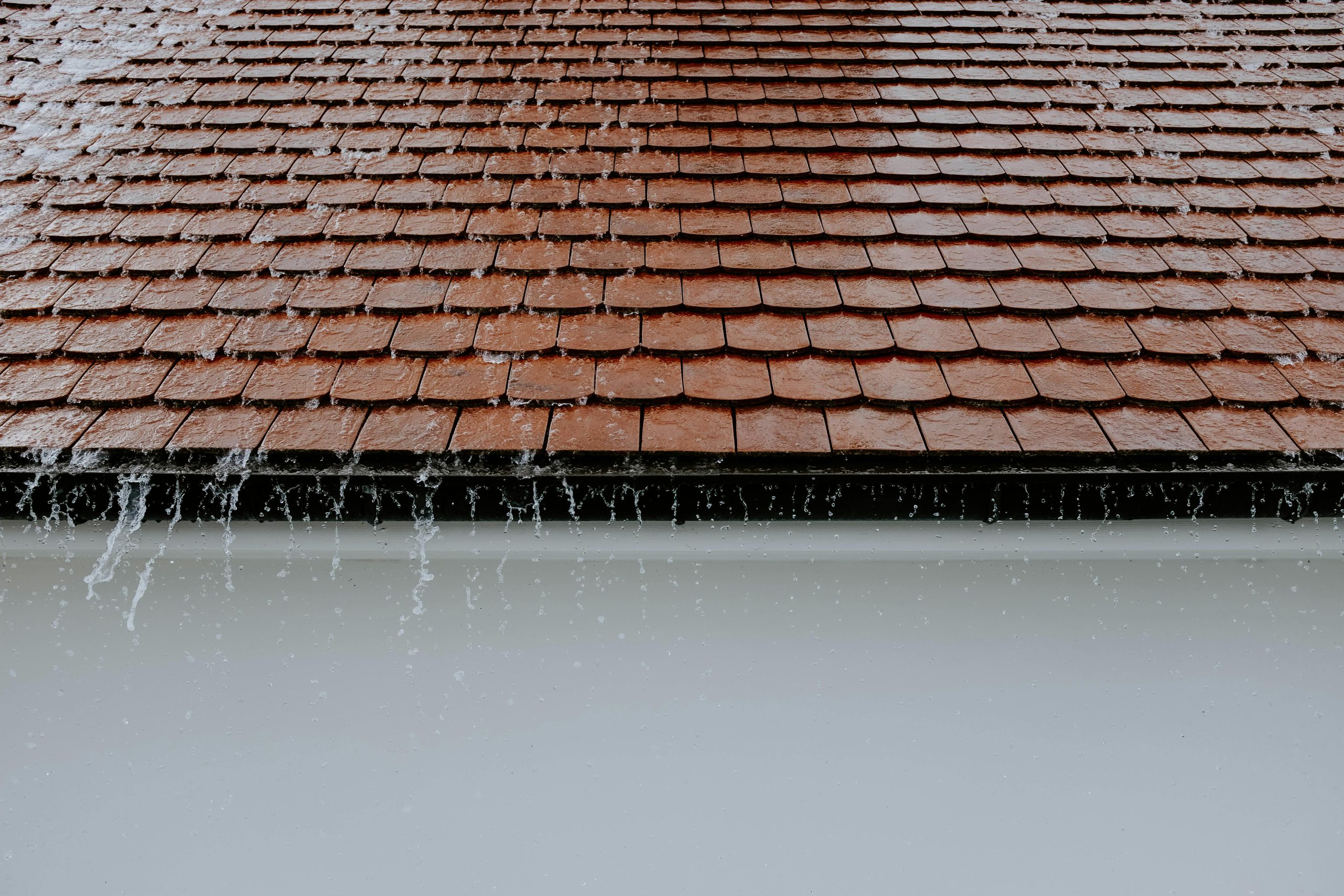
Rely on slope and gravity to shed water off the roof surface. Tiles overlap to channel water downward, but tiles alone are not waterproof — they are the primary shedding layer. Underlayment or sarking beneath the tiles acts as the secondary barrier. Flashings seal the junctions where the roof meets walls, ridges, hips and valleys.
Metal Roofs
Rely on large sheet panels with overlapping joints, sealed with fasteners and sealants. Water is shed by slope and contained by the overlap and seal system. Thermal movement is a constant factor — metal expands and contracts with temperature changes, stressing joints and fastener points over time.
Flat Roof Failure Mechanisms
Waterproofing Membrane Failure
The membrane has cracked, deteriorated, blistered or de-bonded from the substrate.
👉 Water penetrates through the breach and enters the structural slab.
👉 May travel laterally within the slab before surfacing as a ceiling stain in the unit below.
👉 Membrane failure can be caused by UV degradation, foot traffic damage, thermal cycling or poor original application.
Ponding Water
Water accumulates in low spots on the flat roof due to inadequate screed falls, settlement, or deflection of the slab.
👉 Ponding increases hydrostatic pressure on the membrane, accelerating deterioration.
👉 Even a membrane in reasonable condition will fail prematurely under sustained ponding.
👉 Ponding also encourages biological growth, which further degrades the membrane surface.
Parapet and Upstand Junction Failure
The junction where the roof membrane meets the parapet wall or upstand is a critical transition point.
👉 Membrane must turn up the parapet face and be securely terminated.
👉 Failure at this junction — due to debonding, cracking or insufficient height — allows rainwater to bypass the membrane at the roof perimeter.
👉 This is one of the most common flat roof failure points and is frequently overlooked during inspection.
Roof Penetration Failure
Pipes, vents, mechanical plant bases and service penetrations pass through the roof membrane.
👉 Each penetration requires a properly formed collar, flashing boot or sealant detail.
👉 Sealant degradation, pipe boot cracking or movement at the penetration point allows water to enter directly through the slab.
Pitch Roof Failure Mechanisms
Cracked or Displaced Tiles
Individual tiles crack due to impact, thermal stress or age. Tiles may also shift due to wind uplift or deteriorated battens.
👉 Water enters through the crack or gap and reaches the underlayment layer.
👉 If the underlayment is also compromised, water passes through to the roof structure and ceiling below.
Disjointed Tiles
Tiles that have shifted out of alignment create gaps in the overlap pattern.
👉 Water bypasses the tile overlap and enters the roof space.
👉 Common after storm events or on roofs with deteriorated tile clips and battens.
Wind-Driven Rain Backflow
When the roof pitch is insufficient, wind can push rainwater upward beneath the tile overlaps.
👉 Water is forced against gravity, entering from underneath the tiles rather than over them.
👉 This explains leaks that only occur during heavy rain with specific wind directions.
👉 More prevalent on low-pitch roofs and those facing the prevailing monsoon direction.
Valley Gutter Failure
Valley gutters channel water where two roof planes meet at an internal angle.
👉 High water volume concentrates in the valley during heavy rain.
👉 Failure mechanisms include cracked valley linings, corroded metal valley trays, displaced lead or zinc valley flashings, and debris accumulation reducing flow capacity.
👉 Valley gutter leaks can be severe due to the concentrated water volume.
Flashing Failure
Flashings seal the junctions at ridges, hips, wall-to-roof abutments and roof edges.
👉 Lead, zinc or metal flashings can crack, corrode, lift or de-bond from the mortar bed.
👉 Ridge cap mortar deterioration exposes the ridge junction to direct rain entry.
👉 Wall-to-roof abutment flashings are particularly vulnerable — failure allows water to enter the wall cavity and travel downward before surfacing inside.
Underlayment / Sarking Failure
The underlayment beneath tiles acts as a secondary waterproof barrier.
👉 If tiles fail but the underlayment is intact, water is redirected to the gutter.
👉 If both the tile and underlayment fail at the same location, water enters the roof space directly.
👉 Older roofs may have degraded or absent underlayment.
Metal Roof Failure Mechanisms
Fastener and Screw Failure
Self-drilling screws with rubber washers secure metal sheets to purlins.
👉 Rubber washers degrade over time due to UV exposure and thermal cycling.
👉 Over-driven or under-driven screws fail to maintain a watertight seal.
👉 Corrosion around fastener holes enlarges the penetration, allowing water entry.
Overlap and Joint Failure
Metal sheets overlap at side laps and end laps. The overlap direction must oppose the prevailing wind to prevent wind-driven rain from entering the joint.
👉 If overlaps face the wrong direction relative to wind, water is driven into the joint.
👉 Sealant tape or mastic within the overlap deteriorates over time, reducing the seal effectiveness.
Ridge Cap Sealant Failure
Ridge caps cover the apex where two roof slopes meet.
👉 The foam infill strip or sealant between the ridge cap and the profiled sheet degrades with age and UV.
👉 This creates a direct opening for rain entry at the highest point of the roof.
Thermal Movement
Metal roofs expand and contract significantly with temperature changes.
👉 Repeated thermal cycling stresses fastener holes, causing them to elongate.
👉 Joints and flashings can separate at connection points.
👉 This is a progressive failure — worsening incrementally with each thermal cycle.
Cut Edge Corrosion
Where metal sheets have been cut during installation, the protective coating is removed at the cut edge.
👉 Exposed steel corrodes over time, weakening the sheet at the edge.
👉 Corrosion spreads beneath the coating, compromising the sheet beyond the visible damage.
Gutter and Drainage Failures
Gutters are critical to roof system performance. A functional roof with a failed gutter system will still leak.
Metal Gutter Failures
- Joint sealant failure at gutter sections allows water to drip at the join.
- Corrosion perforation creates holes in the gutter base or sides.
- Sagging or misalignment due to failed brackets redirects water over the gutter edge or causes ponding within the gutter.
- Blocked downpipe connections cause water to back up and overflow.
Concrete Gutter Failures
- Cracking of the concrete gutter channel allows water to seep through the structure.
- Waterproofing membrane failure within the gutter channel — concrete gutters rely on an applied membrane just like flat roofs.
- Inadequate falls within the gutter cause ponding, accelerating membrane deterioration.
Drainage Capacity Issues
- Undersized downpipes or outlets cannot handle peak rainfall intensity.
- Debris accumulation (leaves, dirt, moss) reduces effective drainage capacity.
- Overflow during heavy rain causes water to cascade down external walls or enter the roof space from the gutter edge.
👉 Gutter and drainage performance must be assessed as part of any roof leak investigation.
Diagnostic Behaviour: How to Identify Your Roof Leak
The behaviour of the leak relative to rainfall provides the most important diagnostic clues.
Leak only during rain
Likely related to:
- roof covering failure (tiles, metal sheets, membrane)
- flashing or junction failure
- gutter overflow
👉 Observe whether the leak starts immediately with rain onset or with a delay — immediate onset suggests a direct path; delayed onset suggests water accumulation before breakthrough.
Leak only after prolonged rain
Likely related to:
- ponding water on flat roof overwhelming the membrane
- slow seepage through hairline cracks in concrete
- saturated screed beneath a compromised membrane
👉 If the leak does not appear in short rain events but develops after sustained rainfall, the water is accumulating before finding a path through.
Leak worsens with rain intensity
Likely related to:
- drainage capacity being exceeded
- blocked gutters or downpipes
- multiple small entry points that compound under volume
👉 This pattern strongly implicates the drainage system rather than the roof covering itself.
Leak depends on wind direction
Strong indicator of:
- wind-driven rain backflow beneath pitch roof tiles
- rain entry through metal roof ridge caps or overlaps facing the prevailing wind
- rain penetrating wall-to-roof abutment flashings on the windward side
👉 If the leak only occurs with rain from a specific direction, the entry point is on that face of the building.
Leak appears far from roof edge or at an unexpected interior location
Indicates:
- water travelling along structural beams, purlins or the underside of the slab
- water entering at the roof level but migrating within the roof structure before surfacing
👉 Do not assume the ceiling stain location indicates the roof entry point. Trace the structural path upstream.
Leak appears at external wall below roofline
Likely related to:
- gutter overflow cascading down the wall face
- failed wall-to-roof abutment flashing
- parapet capping failure allowing water into the wall cavity from above
👉 Distinguish between water coming down the external face (gutter/capping) and water emerging from within the wall (flashing/cavity).
Verification Methods
Always confirm the diagnosed source before commencing repair.
Localised Water Spray Test
Direct a controlled water spray at specific areas of the roof — one section at a time — while an observer monitors for leakage internally. Systematically work from the lowest point upward to isolate the entry point.
Internal Inspection During Rain
Inspect the roof space (if accessible) during active rainfall. Look for active drips, water trails on beams and purlins, and damp patches on the underside of the roof deck. This is the most direct method for tracing the water path.
Gutter and Drainage Flow Test
Run water through the gutter system at volume. Check for overflow, joint leaks, blockages and drainage speed at outlets and downpipes.
Visual Roof Survey
Inspect the roof surface for cracked or displaced tiles, lifted flashings, deteriorated sealants, corroded fasteners, ponding evidence (tide marks, algae growth), and membrane blistering or cracking. Drone survey is effective for large or inaccessible roofs.
Ponding Check (Flat Roofs)
After rain, inspect the flat roof surface for standing water. Any water remaining more than 48 hours after rainfall indicates inadequate falls or blocked drainage — both of which accelerate membrane failure.
Why Roof Leaks Are Often Misdiagnosed
Common diagnostic mistakes:
- Focusing on where the ceiling stain appears instead of tracing the water path upstream to the roof entry point — the stain location and the entry point are often in completely different positions.
- Patching the visible membrane damage without checking for ponding — if the ponding condition remains, the patch will fail under the same sustained hydrostatic pressure.
- Ignoring drainage system performance — a functional membrane with a failed gutter system will still produce leakage.
- Overlooking wind-driven rain as a factor — leaks that only occur with specific wind conditions are missed when inspections are done in dry weather or calm conditions.
- Replacing tiles without checking underlayment, valley gutters and flashings — tile replacement addresses only the outermost layer of a multi-layer system.
👉 Roof leaks require system-level diagnosis, not point repairs.
These issues are frequently encountered in practice, particularly in cases where repairs have been carried out without assessing the full roof system and drainage performance.
Summary
Roof leaks in Singapore are influenced by weather, drainage and overall system condition.
👉 Water often travels along structural paths before becoming visible — the ceiling stain is not the entry point
👉 Rain intensity, duration and wind direction are critical diagnostic clues
👉 Drainage performance is as important as the roof covering itself
👉 Flat, pitch and metal roofs each fail through different mechanisms requiring different diagnostic approaches
👉 Always verify the source through systematic testing before commencing repair
Understanding the type of roof system and how water behaves within it is key to identifying the true source of leakage.
Not Sure Where Your Roof Leak Is Coming From?
Roof leaks often involve multiple contributing factors — including membrane condition, drainage performance, flashing details and wind-driven rain behaviour. The visible leak location rarely indicates the true entry point.
If you are dealing with ceiling leaks during rain, recurring roof leakage or uncertainty about the source, a proper diagnosis should be carried out before any repair is attempted.
You may request a professional leak assessment from Flux Solutions to accurately identify the entry point and determine the correct repair approach.